
What is Hernias ?
Hernia is a common medical condition that can occur in different parts of the body. It occurs when internal organs or tissues of the body protrude through a weakened muscle or tissue layer. This problem can occur in all age groups and may arise due to various reasons. In this article, we will discuss in detail about the different types of hernia, its causes, symptoms, treatment methods and preventive measures. .
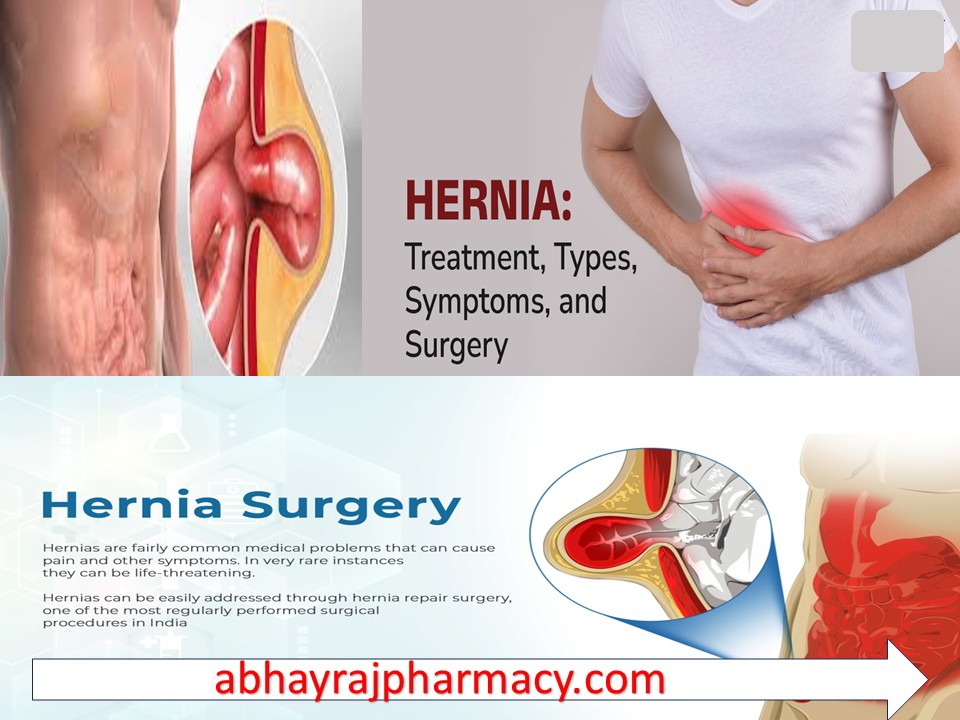
Is a condition in which the body experiences an abnormal swelling or bulge due to the protrusion of any internal organ or tissue. This bulge is usually seen around the oblique waist and it may grow over time.
What is type ?
There are different types which are classified according to their location and cause-
Inguinal Hernia – This is the most common type of hernia and is mostly seen in men. It occurs when a portion of the intestine or fat is pushed outward due to weak muscles in the lower back.
Femoral Hernia – It is particularly common in women.
This condition occurs when a portion of the intestine protrudes into the upper thigh region.
Umbilical
It develops around the navel and is commonly seen in new born .
It can also occur in adults, especially after pregnancy or due to obesity.
Incisional – It occurs when tissue protrudes from previous surgeries.
It is more common in individuals who have previously undergone abdominal surgery.
Diaphragmatic – This condition occurs when the abdominal organs push upward through the diaphragm (which separates the chest and abdomen).
What is Causes ?
There are several possible causes of a hernia. Some of these are natural, while some depend on the lifestyle of the individual.
Congenital
Congenital weakness in the abdominal wall.
Failure to develop properly during pregnancy.
Acquired Excessive strain on the muscles** – while lifting heavy weights, indulging in prolonged coughing, or during constipation.
Obesity – Excess weight puts stress on the body, which can increase the chances of developing.
Pregnancy
This can put pressure on the abdominal muscles, which can result.
Post-operative weakness – If the abdomen has undergone an operation, there is a possibility formation.
What is Symptoms of Hernia ?
The symptoms of a hernia are usually obvious, although sometimes it can occur without any pain.
Main features
– A bulge or swelling is visible in the affected area.
– Pain or discomfort is experienced when lifting heavy or applying force.
– Discomfort is experienced when standing for long periods.
– A burning or pulling sensation is felt in some circumstances.
Severe symptoms
If not treated, it can become severe and its symptoms can be as follows:
– Severe pain and swelling.
– The hernia affected area becomes hard or red.
– Feeling of nausea and vomiting.
– The hernia should not go inside when pressed.
If these symptoms are seen, contact the doctor immediately.
How is detected ?
Usually identified through physical examination and various medical tests.
What is Physical Examination ?
– The doctor can diagnose hernia by observing and touching the affected area.
– The doctor may ask the patient to stand up or cough, so that the hernia can be seen clearly.
Imaging tests** – **Ultrasound** – To determine the location and type.
MRI and CT scan – If the hernia is not clearly identified, these tests are done.
Treatment of hernia
Treated based on its type and severity-
Medication and lifestyle changes
– The doctor may recommend lifestyle changes in cases of mild .
– Take a fiber-rich diet to avoid constipation.
– Avoid lifting heavy objects.
surgery
If the pain is increasing, an operation may be required.
Open Surgery- In this, the area affected by treated surgically, and mesh is used to strengthen the muscles.
Surgery laparoscopic
– This is a technique that uses less cutting, which leads to faster recovery.
– In this, the hernia is treated with the help of a miniature camera.
What are the measures to avoid ?
Adopt a healthy lifestyle
– Exercise regularly to keep your abdominal muscles strong.
– Control your weight.
. Proper diet
– Avoid fat
